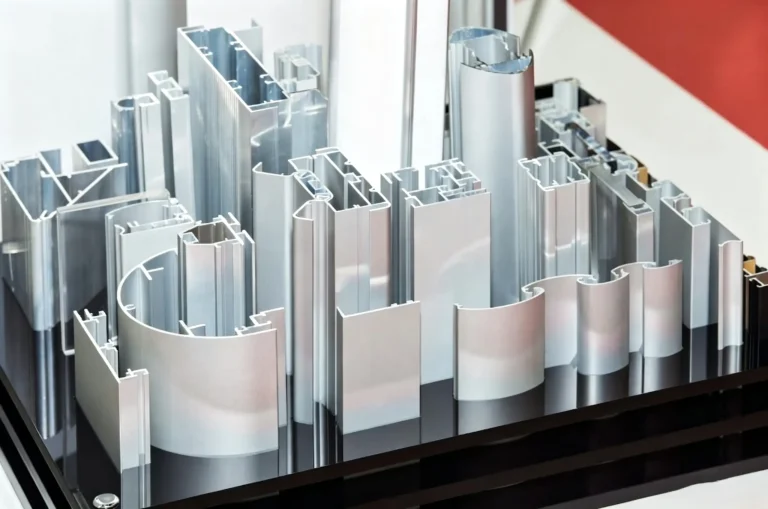
The aluminum extrusion process forces a heated aluminum billet through a shaped die to produce a continuous profile with a specific cross-section. The billet is heated until it becomes sufficiently soft and plastic for extrusion, but it remains solid rather than melting into a liquid. After the profile exits the die, manufacturers typically cool, stretch, cut, heat-treat, and finish it according to the required specifications.
What Is the Aluminum Extrusion Process?
Aluminum extrusion is a metal-forming process used to manufacture aluminum profiles with consistent cross-sectional shapes.
The basic principle is straightforward:
Heated aluminum billet → Extrusion press → Die → Aluminum profile
A hydraulic ram applies substantial pressure to an aluminum billet inside the extrusion press. The softened aluminum flows through the opening in the die and emerges with the same cross-sectional geometry as the die opening.
This makes extrusion particularly useful for producing long profiles with complex or customized cross-sections.
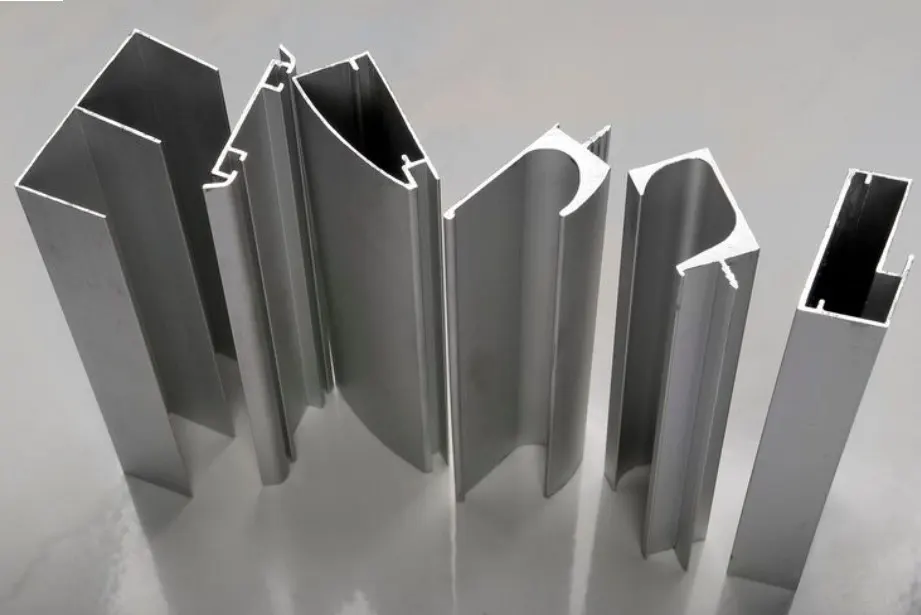
Common extruded shapes include:
- Angles
- Channels
- Tubes
- Bars
- Beams
- Heat-sink profiles
- Custom architectural profiles
Extruded profiles can generally be classified as solid, hollow, or semi-hollow depending on their cross-sectional geometry.
How Does Aluminum Extrusion Work?
Although the basic principle is simple, industrial aluminum extrusion involves several controlled stages. Temperature, pressure, die geometry, alloy selection, cooling, and subsequent heat treatment all influence the final profile.
1. Aluminum Billet Preparation
The process starts with an aluminum alloy billet, which is a solid cylindrical piece of aluminum extrusion feedstock.
The selected alloy depends on the required combination of:
- Strength
- Corrosion resistance
- Extrudability
- Surface finish
- Thermal conductivity
- Final application
Common extrusion alloys include various 6000-series aluminum alloys, particularly where a balance of extrudability and mechanical performance is required.
2. Billet Heating
The billet is heated before entering the extrusion press.
The purpose is not to melt the aluminum. Instead, heating increases its plasticity and reduces the force required to push it through the die.
The melting point of aluminum is approximately 660°C (1,220°F), while extrusion commonly occurs at substantially lower temperatures. The Aluminum Extrusion Council notes typical billet temperatures above about 375°C (700°F), with the exact temperature depending on the alloy and process.
For this reason, aluminum extrusion should not be confused with casting.
Casting: aluminum is melted and poured into a mold.
Extrusion: a heated, softened solid billet is forced through a die.
3. Extrusion Die Preparation
The extrusion die determines the cross-sectional shape of the finished aluminum profile.
Before production, the die is prepared and heated to suitable process conditions. Proper die preparation helps promote consistent material flow and reduces thermal shock.
The complexity of the die depends on the profile being produced.
Solid Profiles
Solid profiles have no enclosed internal voids.
Examples include:
- Bars
- Rods
- Angles
- Flat profiles
Hollow Profiles
Hollow profiles contain one or more enclosed internal spaces.
Examples include:
- Tubes
- Hollow structural profiles
- Rectangular sections
Semi-Hollow Profiles
Semi-hollow profiles contain a partially enclosed void.
The die design becomes increasingly important as profile geometry becomes more complex because different sections of the die can experience different levels of material flow and pressure.
4. Billet Loading and Extrusion
The heated billet is transferred into the extrusion press and placed inside a container.
A hydraulic ram then applies high pressure to the billet.
As the ram moves forward, the billet fills the container and is forced against the extrusion die. Because the aluminum cannot expand through the container walls, the increasing pressure drives the softened material through the die opening.
The aluminum emerges from the other side as a continuous profile matching the die’s cross-sectional shape.
This is the defining stage of the aluminum extrusion manufacturing process.
5. Profile Runout and Quenching
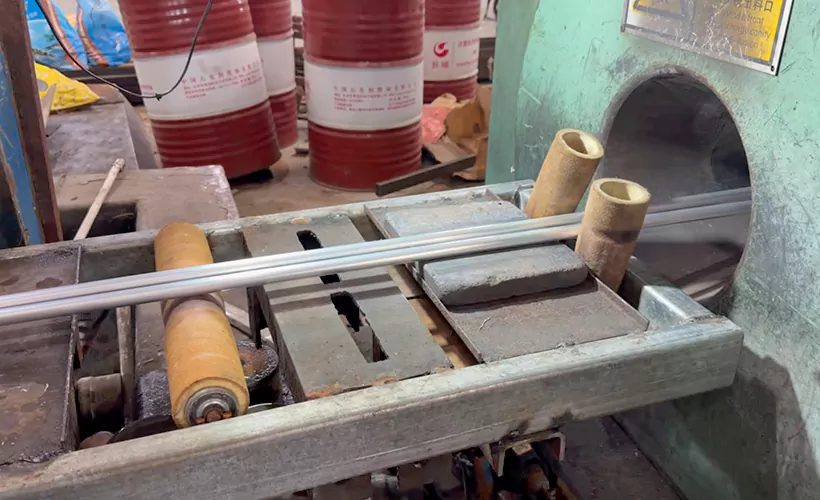
The newly extruded profile leaves the die at an elevated temperature and moves along a runout table.
A puller can guide the profile away from the press at a controlled speed while the material is cooled.
Depending on the alloy and required properties, manufacturers may use:
- Air cooling
- Fans
- Water
- Other controlled cooling methods
This stage is known as quenching.
Quenching can be particularly important for heat-treatable aluminum alloys because the cooling rate influences the metallurgical condition of the material.
6. Cutting to Length
The continuously produced extrusion is separated into manageable lengths.
The initial cut may produce standard table lengths, which are subsequently cooled and processed further.
Final cutting can then produce the exact lengths required for the application.
7. Cooling and Stretching
After leaving the press, the aluminum profile may still contain residual stresses and slight distortion.
Manufacturers can use a stretcher to pull the profile under controlled tension.
This helps:
- Straighten the profile
- Correct twisting
- Reduce distortion
- Bring dimensions within specification
Stretching is therefore more than simply making the profile look straight. It is part of controlling the dimensional quality of the finished extrusion.
8. Aging and Heat Treatment
Some aluminum alloys require additional heat treatment to achieve the desired mechanical properties.
For example, heat-treatable alloys can undergo controlled aging to increase strength and hardness.
Depending on the alloy and process, manufacturers may produce tempers such as T5 or T6.
The exact heat-treatment process depends on the aluminum alloy and required mechanical properties, so not every extruded aluminum profile receives the same treatment.
9. Surface Finishing
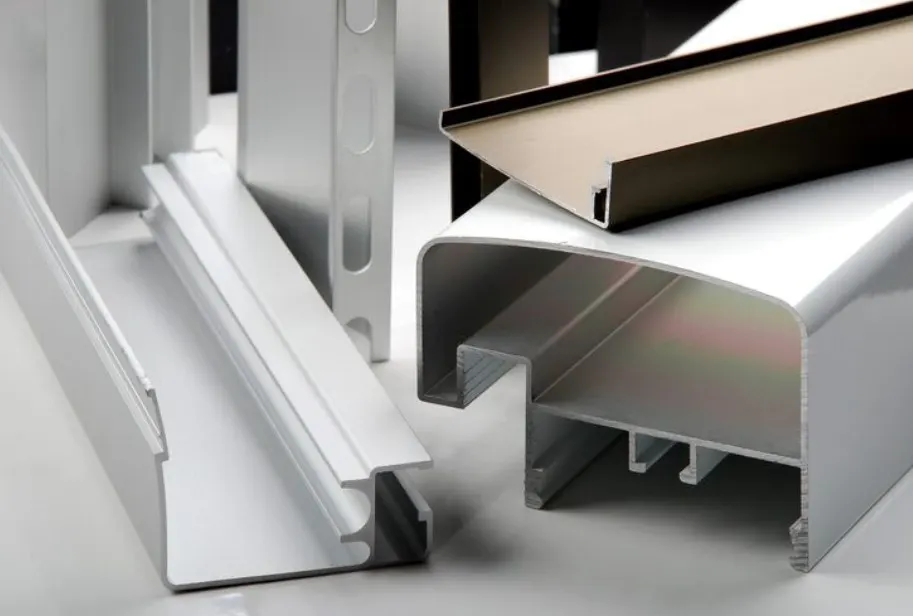
After extrusion and heat treatment, aluminum profiles can receive different surface treatments.
Common aluminum extrusion finishing methods include:
Anodizing
Anodizing increases the thickness of aluminum’s naturally occurring oxide layer. It can improve corrosion resistance, wear resistance, and appearance.
Powder Coating
Powder coating provides a durable decorative and protective surface and is available in a wide range of colors.
Painting
Paint systems can provide specific colors and surface protection depending on the application.
Sandblasting
Sandblasting can modify the surface appearance and texture.
The appropriate finish depends on the required appearance, corrosion protection, wear resistance, and environmental exposure.
10. Fabrication and Final Processing
Extrusion creates the basic profile, but many applications require additional fabrication before the aluminum is ready for assembly.
Depending on the design, manufacturers may:
- Cut
- Drill
- Punch
- Mill
- Machine
- Bend
- Weld
- Assemble
For example, an extruded heat sink may undergo additional machining to create a specific fin configuration, while a structural profile may require drilled holes for fastening.
Therefore, the aluminum extrusion process is often only one part of the complete aluminum profile manufacturing process.
Direct vs. Indirect Aluminum Extrusion
Direct extrusion is the most familiar extrusion configuration. The ram pushes the billet toward the stationary die, and the aluminum flows through the die in the direction of ram movement.
Indirect extrusion uses a different arrangement in which the die moves into the billet, reducing some of the relative friction between the billet and container.
| Feature | Direct Extrusion | Indirect Extrusion |
|---|---|---|
| Billet movement | Material flows toward the die | Die moves into the billet |
| Container friction | Higher | Lower |
| Process complexity | Relatively straightforward | More specialized |
| Typical use | Widely used | Selected applications |
The choice depends on factors such as alloy, profile geometry, press capability, dimensional requirements, and production objectives.
What Temperature Is Aluminum Extruded At?
There is no single extrusion temperature that applies to every aluminum alloy.
The process temperature depends on:
- Aluminum alloy
- Billet diameter
- Profile geometry
- Extrusion speed
- Die design
- Press conditions
- Required mechanical properties
As a general reference, the Aluminum Extrusion Council describes billet temperatures commonly above 375°C (700°F) and potentially up to around 500°C (930°F) depending on the alloy. This remains below aluminum’s approximately 660°C (1,220°F) melting point.
The important distinction is:
Aluminum extrusion uses heat to soften the billet and improve plastic flow, not to turn the billet into liquid aluminum.
What Role Does the Extrusion Die Play?
The die is one of the most important components in the entire process because it determines the profile’s basic geometry.
A well-designed die must account for factors such as:
- Profile shape
- Wall thickness
- Material flow
- Alloy
- Extrusion speed
- Die strength
- Thermal conditions
For complex profiles, different portions of the die may experience different material-flow conditions. Poor die design can contribute to uneven flow, dimensional variation, surface defects, or excessive die wear.
This is why aluminum extrusion die design is closely connected to both product quality and manufacturing cost.
Why Is Aluminum Extrusion Used?
Aluminum extrusion is widely used because it allows manufacturers to produce complex, continuous profiles efficiently.
Complex Cross-Sections
A single extrusion can integrate features such as:
- Channels
- Ribs
- Grooves
- Flanges
- Mounting sections
- Heat-dissipation fins
This can reduce the need to assemble multiple individual components.
Lightweight Construction
Aluminum has relatively low density compared with many structural metals, making extruded aluminum attractive where weight reduction matters.
Design Flexibility
Changing the die allows manufacturers to produce different cross-sectional geometries for different applications.
Good Corrosion Resistance
Aluminum naturally forms an oxide layer that provides a degree of corrosion protection, while additional finishing can further improve surface performance.
Thermal and Electrical Conductivity
Aluminum’s thermal and electrical properties make extrusions useful for applications such as heat sinks, electrical components, and thermal-management systems.
Material Efficiency
Extrusion can produce long, continuous profiles with complex cross-sections, making it an efficient manufacturing approach for many applications.
What Are Aluminum Extrusions Used For?
Aluminum extrusion is used across a wide range of industries.
Construction
- Window and door frames
- Curtain walls
- Structural profiles
- Railings
- Architectural systems
Automotive
- Structural components
- Heat-management components
- EV battery-related structures
- Interior and exterior components
Electronics
- Heat sinks
- Enclosures
- Frames
- Thermal-management components
Solar Energy
- Solar panel frames
- Mounting systems
- Structural components
Industrial Equipment
- Machine frames
- Conveyor structures
- Automation equipment
- Guarding systems
Aerospace and Transportation
Aluminum’s low density and useful mechanical properties make extruded profiles suitable for selected aerospace and transportation applications.
Aluminum Extrusion Process vs. Aluminum Casting
The two processes are sometimes confused, but they produce components in fundamentally different ways.
| Aluminum Extrusion | Aluminum Casting | |
|---|---|---|
| Starting material | Solid billet | Molten aluminum |
| Main forming method | Forces material through a die | Pours/injects metal into a mold |
| Typical output | Continuous profiles | Individual cast parts |
| Cross-section | Generally consistent along length | Can vary throughout the part |
| Typical products | Profiles, tubes, channels, rails | Housings, complex cast components |
Extrusion is particularly advantageous when the product requires a long, consistent cross-sectional profile.
FAQs
The aluminum extrusion process forces a heated aluminum billet through a shaped die to produce a continuous profile with a predetermined cross-section.
A solid aluminum billet is heated, placed into an extrusion press, and pushed against a die by a hydraulic ram. The softened aluminum flows through the die and emerges as a continuous profile.
No. In normal extrusion, the billet is heated and softened but remains solid. The process temperature is below aluminum’s melting point.
The main stages include billet preparation, heating, die preparation, extrusion, quenching, cutting, cooling, stretching, aging or heat treatment, and finishing or fabrication.
The extrusion die controls the cross-sectional geometry of the profile by providing the opening through which the softened aluminum flows.
Direct extrusion pushes the billet toward a stationary die, while indirect extrusion uses a different die-and-billet arrangement that reduces some billet-to-container friction.
After extrusion, profiles may be quenched, stretched, cut, aged or heat-treated, surface-finished, and fabricated into their final dimensions.
Conclusion
The aluminum extrusion process transforms a heated solid aluminum billet into a continuous profile by forcing it through a shaped die. The quality of the finished extrusion depends not only on the press itself, but also on alloy selection, billet and die temperature, die design, material flow, cooling, stretching, heat treatment, and finishing.
Understanding these stages helps explain why aluminum extrusion can produce everything from simple channels and tubes to highly complex profiles for construction, automotive, electronics, energy, and industrial applications.
Looking for reliable heat-resistant felt components for aluminum extrusion? Contact us at [email protected] to discuss your application and material requirements.