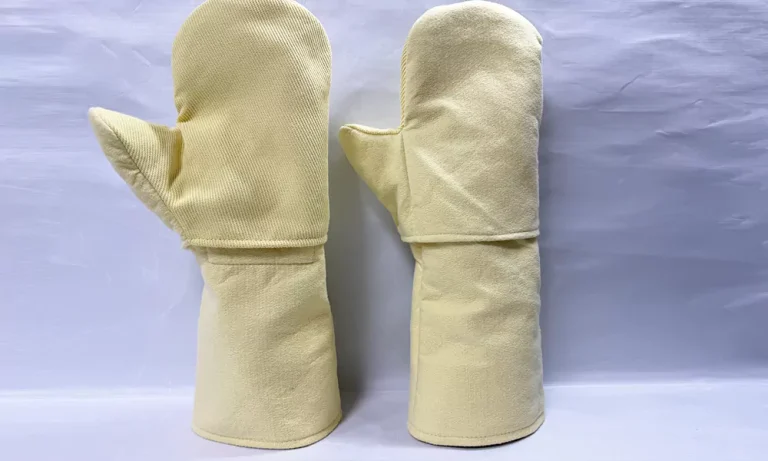
Kevlar® gloves are protective gloves that incorporate Kevlar, a para-aramid fiber, into the glove liner, yarn, stitching, reinforcement, or outer construction. They are widely used when workers need a combination of cut resistance, heat resistance, flame resistance, abrasion resistance, and mechanical strength. However, not every Kevlar glove provides the same protection. The finished glove’s construction, fiber blend, coating, thickness, and tested performance determine whether it is suitable for a particular task.
What Are Kevlar Gloves?
Kevlar gloves are protective gloves that use Kevlar fiber as part or all of their construction. Kevlar is a synthetic para-aramid fiber known for its high strength-to-weight ratio, resistance to cuts and abrasion, and inherent resistance to heat and flame.
Manufacturers can use Kevlar in several ways. A glove may contain:
- A knitted Kevlar liner
- Kevlar-blended yarn
- A Kevlar outer layer
- Kevlar stitching
- Kevlar reinforcement in high-wear areas
- A Kevlar layer combined with leather or another outer material
This distinction matters because “Kevlar glove” does not describe one standardized glove construction.
For example, a lightweight knitted glove designed for handling sharp sheet metal can have very different properties from a leather glove with a Kevlar liner designed for welding or hot-metal handling.
Why Is Kevlar Used in Protective Gloves?
Kevlar provides a combination of properties that is difficult to obtain from many conventional fibers.
Cut Resistance
Kevlar’s high strength makes it useful in gloves designed to protect hands from sharp edges, blades, sheet metal, glass, and other cutting hazards.
However, the cut resistance of a finished glove does not come from the fiber alone. DuPont notes that material construction, basis weight, fabric construction, and coatings can all affect cut performance.
Heat Resistance
Kevlar also provides useful thermal performance. The fiber does not melt or drip like conventional thermoplastic fibers and has inherent resistance to heat and flame.
This makes Kevlar useful when a task combines sharp edges with elevated temperatures, such as handling hot metal components.
The important qualification is that the finished glove still needs appropriate thermal testing. A Kevlar fiber’s heat resistance does not automatically give every glove made with Kevlar the same temperature rating.
Flame Resistance
Kevlar has inherent flame-resistant properties and does not readily support flame propagation. This is particularly useful in protective gloves and other industrial PPE where workers may encounter sparks, flame, or thermal hazards.
Abrasion Resistance
Industrial gloves often experience repeated contact with rough surfaces, metal edges, tools, and machinery. Kevlar’s mechanical durability can contribute to longer-lasting protective glove constructions.
Strength at Low Weight
Kevlar combines high strength with relatively low weight, allowing manufacturers to develop protective glove constructions without necessarily making them extremely bulky.
This can be important when workers need both protection and sufficient dexterity for handling tools or components.
What Are Kevlar Gloves Used For?
Kevlar gloves are used across industries where workers face mechanical hazards, thermal hazards, or both.
Metal Handling
Metalworking is one of the most common applications.
Workers may handle:
- Sheet metal
- Metal components
- Machined parts
- Stamped parts
- Metal edges
- Hot components
These tasks can involve both cut hazards and heat exposure, making a Kevlar-based glove useful when the construction is designed and tested for both.
Welding and Metalworking
Welding environments can expose workers to:
- Sparks
- Hot particles
- Heat
- Abrasion
- Sharp metal
- Rough surfaces
Some industrial gloves combine Kevlar with leather or other materials to provide a balance between thermal protection, durability, and dexterity. Commercial industrial gloves using Kevlar-based constructions are available with both cut and thermal ratings, demonstrating how the fiber can form part of a multi-hazard glove design.
However, welding gloves should always be selected according to the actual welding process and thermal exposure rather than simply choosing a product labeled “Kevlar.”
Glass Handling
Glass edges can create severe cut hazards. Kevlar-based gloves can provide useful cut protection while maintaining relatively low weight and flexibility.
Automotive Manufacturing
Automotive manufacturing involves many operations where workers handle:
- Stamped metal
- Machined components
- Sharp edges
- Hot components
- Abrasive parts
Kevlar-based gloves can be used where mechanical protection needs to coexist with thermal performance.
Foundry and Hot-Metal Handling
Foundry environments can combine high temperatures with heavy and abrasive materials. In these applications, the glove needs to provide more than cut protection.
Thermal performance, cuff length, insulation, durability, and the ability to handle the specific hot material all need to be considered.
General Industrial Assembly
Kevlar gloves can also be used for industrial assembly and maintenance where workers need protection against sharp components while retaining enough dexterity to operate tools.
What Protection Do Kevlar Gloves Provide?
A Kevlar glove can provide several types of protection, but the exact protection level belongs to the finished glove, not simply to the word “Kevlar.”
| Protection | What Kevlar Can Contribute |
|---|---|
| Cut resistance | High-strength fiber construction |
| Heat resistance | Thermal stability and resistance to melting |
| Flame resistance | Inherent flame-resistant properties |
| Abrasion resistance | Durable fiber structure |
| Mechanical strength | High tensile strength |
| Dexterity | Lightweight knitted constructions can maintain flexibility |
The actual result depends on the complete glove design.
For example, Ansell offers Kevlar-containing gloves with different constructions and different tested performance levels, including products combining Kevlar with nylon, acrylic, or other technologies.
Are Kevlar Gloves Cut Resistant?
Yes, Kevlar is widely used to provide cut resistance in protective gloves. But not every Kevlar glove has the same cut rating.
Cut resistance depends on factors including:
- Fiber type
- Fiber blend
- Yarn construction
- Knitting gauge
- Fabric weight
- Fabric construction
- Coating
- Thickness
- Reinforcement
DuPont specifically points out that cut protection is a combination of these factors rather than simply the material name.
For this reason, you should compare the tested cut rating of the exact glove model rather than assuming that a glove containing more Kevlar will always provide greater cut protection.
Are Kevlar Gloves Heat Resistant?
Kevlar fiber is inherently heat resistant, but not every Kevlar glove should automatically be considered a heat-resistant glove.
This distinction is important.
A glove may contain Kevlar but also include:
- Nitrile
- PU
- Latex
- Nylon
- Polyester
- Leather
- Other synthetic fibers
These materials can have different thermal limits.
The construction can therefore determine the glove’s actual thermal performance.
For example, some commercially available Kevlar-engineered gloves carry specific EN 407 or ANSI thermal ratings, while others are designed primarily for cut protection.
Always check the thermal performance of the complete glove when heat is part of the hazard.
Are Kevlar Gloves Fire Resistant?
Kevlar has inherent flame-resistant properties and does not melt or drip like many thermoplastic fibers. DuPont’s PPE documentation describes 100% Kevlar constructions as resistant to thermal degradation and capable of meeting specific flame and heat protection requirements.
However, fire resistance is not the same as unlimited fire protection.
The glove’s:
- Outer material
- Coating
- Seams
- Liner
- Cuff
- Thickness
- Construction
can all affect its behavior in a fire or flame exposure.
For direct flame hazards, look for relevant flame and thermal test results for the finished glove.
Are Kevlar Gloves Puncture Resistant?
Not necessarily.
Cut resistance and puncture resistance measure different hazards.
A glove can have strong cut resistance without providing the level of puncture protection required against:
- Needles
- Nails
- Wires
- Thorns
- Sharp pointed objects
Therefore, if puncture is part of the workplace hazard, check the glove’s specific puncture test result rather than using its cut rating as a substitute.
This is particularly important when comparing gloves because ANSI and EN standards evaluate different mechanical hazards separately.
Types of Kevlar Gloves
Kevlar can be incorporated into several different glove constructions.
Knitted Kevlar Gloves
Knitted gloves use Kevlar yarn to create a lightweight protective structure.
They can offer:
- Good flexibility
- Close hand fit
- Breathability
- Cut protection
- Useful thermal performance
They are often suitable for material handling, assembly, and applications where dexterity matters.
Kevlar Gloves With Coatings
A knitted Kevlar liner can receive a coating such as:
- PU
- Nitrile
- Latex
The coating can improve grip and may provide additional resistance to abrasion, oils, or moisture.
However, the coating also becomes part of the glove’s overall performance and may influence its thermal suitability.
Leather Gloves With Kevlar Liners
Manufacturers can combine a leather outer glove with a Kevlar liner.
This construction can provide a combination of:
- Abrasion resistance
- Mechanical durability
- Cut resistance
- Thermal protection
- Grip
This type of construction is particularly relevant to demanding industrial applications.
Kevlar-Reinforced Gloves
Kevlar does not always need to cover the entire glove.
Manufacturers can reinforce high-wear or high-risk areas such as:
- Thumb crotch
- Fingertips
- Palm
- Seams
- Back of hand
This approach allows protection to be concentrated where workers need it most. Commercial PPE manufacturers already use 100% Kevlar reinforcement in specific high-wear areas such as the thumb crotch.
Kevlar vs. HPPE Gloves
Kevlar and HPPE are both widely used in cut-resistant glove constructions, but they have different characteristics.
| Property | Kevlar | HPPE |
|---|---|---|
| Fiber type | Para-aramid | Polyethylene |
| Cut protection | Excellent potential | Excellent potential |
| Heat resistance | Strong | More limited |
| Flame resistance | Inherently resistant | Not a primary advantage |
| Weight | Lightweight | Very lightweight |
| Flexibility | Good | Excellent |
| High-temperature applications | Well suited when properly constructed | More limited |
| Typical strength | High | Very high strength-to-weight ratio |
The right choice depends on the hazard.
Kevlar becomes particularly attractive when cut protection and elevated-temperature exposure occur together. HPPE can be attractive when low weight, flexibility, and cut protection are the primary requirements.
Neither material automatically makes a glove superior. Compare the exact glove’s construction and test results.
Kevlar Gloves vs. Leather Gloves
Kevlar and leather serve different purposes, and manufacturers can also combine them.
A knitted Kevlar glove may provide:
- Lightweight construction
- Cut resistance
- Flexibility
- Thermal resistance
Leather can provide:
- Abrasion resistance
- Mechanical durability
- Grip
- Protection from rough surfaces
A leather glove with a Kevlar liner can therefore combine the advantages of both materials.
The best choice depends on whether the dominant hazard is cutting, heat, abrasion, handling durability, or a combination of these.
How to Choose the Right Kevlar Gloves
Choosing a Kevlar glove should begin with the hazard, not the material name.
1. Identify the Primary Hazard
Determine whether the main risk is:
- Cutting
- Abrasion
- Puncture
- Contact heat
- Radiant heat
- Convective heat
- Flame
- Molten-metal splash
- A combination of hazards
Different hazards require different test data.
2. Determine the Required Cut Protection
If sharp edges or blades are involved, compare the glove’s tested cut performance under the relevant standard.
ANSI/ISEA 105 and EN 388 use different classification systems, so their ratings should not be treated as interchangeable numbers or letters. DuPont also recommends considering the test method, fabric construction, and other variables when comparing cut-resistant products.
3. Consider Temperature and Exposure Time
For heat-related applications, ask:
- How hot is the surface?
- How long will contact last?
- Is the heat direct or radiant?
- Are sparks present?
- Is there an open flame?
- Is the worker handling molten material?
A glove designed for brief contact with a hot component may not be appropriate for continuous exposure to radiant heat.
4. Check the Coating
Coatings can improve:
- Grip
- Oil resistance
- Wet handling
- Abrasion resistance
But the coating also affects flexibility, breathability, and thermal performance.
5. Consider Dexterity
A thicker or heavily reinforced glove may provide additional protection but can reduce fingertip sensitivity.
For precision assembly or tool handling, a thinner construction may be preferable if it still meets the required protection level.
6. Check the Cuff and Coverage
If the hazard extends beyond the hand, consider:
- Knit cuff
- Extended cuff
- Wrist protection
- Forearm coverage
The glove should match the actual area exposed to the hazard.
How Are Kevlar Gloves Rated?
Two important standards commonly appear when evaluating protective gloves.
ANSI/ISEA 105
ANSI/ISEA 105 provides performance classifications for hand protection, including cut resistance and thermal properties.
Current commercial products may, for example, carry ANSI cut levels such as A4 or A5 depending on their tested construction.
EN 388
EN 388 covers mechanical risks such as:
- Abrasion
- Cut
- Tear
- Puncture
- Impact, where applicable
The cut result from the ISO 13997 method is represented using levels from A through F.
EN 407
EN 407 addresses thermal risks and evaluates properties such as:
- Limited flame behavior
- Contact heat
- Convective heat
- Radiant heat
- Small splashes of molten metal
- Large quantities of molten metal
These tests matter because “heat resistant” is not a single type of protection. A glove designed for contact heat is not necessarily designed for prolonged radiant heat or molten-metal exposure.
Common Mistakes When Choosing Kevlar Gloves
Assuming Every Kevlar Glove Has the Same Protection
Kevlar can be used as a liner, yarn blend, stitching material, or reinforcement. The finished construction determines performance.
Choosing Based Only on Fiber Content
A glove containing 100% Kevlar is not automatically the best glove for every application.
A blended yarn or multi-layer construction may provide better grip, flexibility, abrasion resistance, or thermal performance for a particular task.
Confusing Cut Resistance With Puncture Resistance
Cut and puncture are different hazards and require different performance data.
Assuming Heat Resistance Means Unlimited Temperature Protection
Kevlar is inherently heat resistant, but the finished glove has its own limitations.
Check the complete glove’s thermal test results rather than relying on the fiber name.
Choosing the Highest Rating Without Considering Usability
The highest possible protection level is not always the most practical option.
If a glove is too thick, too stiff, or difficult to grip with, workers may avoid wearing it or struggle to perform precise tasks.
The right glove balances protection, dexterity, grip, durability, comfort, and the actual hazards of the job. DuPont similarly identifies hazard, dexterity, durability, grip, comfort, and value-in-use as important considerations when specifying protective gloves.
FAQs
What are Kevlar gloves used for?
Kevlar gloves are commonly used for applications involving cut, abrasion, heat, or flame hazards, including metal handling, glass handling, automotive manufacturing, welding-related work, and industrial assembly.
Are Kevlar gloves cut resistant?
Yes. Kevlar is widely used in cut-resistant gloves, but the actual cut level depends on the complete glove construction and test method.
Are Kevlar gloves heat resistant?
Kevlar fiber has inherent heat resistance, but the finished glove’s thermal performance depends on its complete construction. Always check the glove’s specific thermal rating.
Are Kevlar gloves fire resistant?
Kevlar has inherent flame-resistant properties. However, the finished glove should be evaluated using relevant flame and thermal test results for the intended application.
Are Kevlar gloves puncture resistant?
Not automatically. Cut resistance and puncture resistance are different properties. Check the specific puncture rating when pointed hazards are involved.
Are Kevlar gloves better than HPPE gloves?
Neither is universally better. Kevlar is particularly useful when cut resistance must be combined with heat or flame resistance, while HPPE is often attractive for lightweight and flexible cut-resistant applications.
Can Kevlar gloves be used for welding?
Some Kevlar-based gloves are designed for welding and other high-temperature applications, but the glove must have suitable thermal and flame protection for the specific welding process.
How long do Kevlar gloves last?
Service life depends on the glove construction, frequency of use, abrasion, contamination, washing, temperature exposure, and workload. Replace gloves when the material or protective construction no longer provides the required protection.
Conclusion
Kevlar gloves are not defined by a single protective property. Their main advantage is the ability to combine cut resistance, mechanical strength, heat and flame resistance, and relatively low weight in a protective glove construction.
The right Kevlar glove depends on the actual hazard. Look beyond the word “Kevlar” and evaluate the complete construction, including the liner, yarn, coating, reinforcement, cuff, and relevant test results. Standards such as ANSI/ISEA 105, EN 388, and EN 407 can help you compare the protection provided by the finished glove.
For industrial applications, the best glove is not necessarily the one with the highest rating. It is the one that provides the right combination of protection, dexterity, grip, durability, and thermal performance for the actual working conditions.
Looking for the right Kevlar glove solution for your application? Contact us at [email protected] to discuss your requirements.