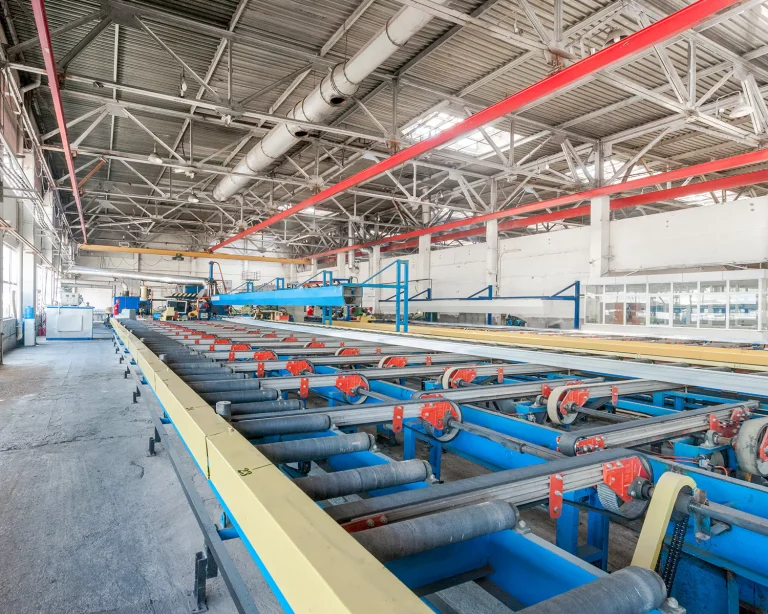
An endless belt is a continuous-loop belt designed to run around pulleys, rollers, or other rotating components without requiring the operator to connect two loose ends during installation. However, “endless” does not always mean “seamless.” Some belts form a truly jointless loop during manufacturing, while others become endless through welding, vulcanization, or mechanical joining. The difference can affect running stability, durability, surface consistency, and suitability for specific industrial applications.
What Is an Endless Belt?
An endless belt forms a closed loop that continuously circulates around a conveying or transmission system. Manufacturers can produce this loop directly during manufacturing or create it by joining the two ends of an open-ended belt.
This distinction matters because an endless belt and a truly seamless belt are not necessarily the same thing.
A truly endless or seamless belt has no splice or connection point. A joined belt, in contrast, uses a welded, vulcanized, mechanically fastened, or otherwise connected section to create the loop. The joint can influence the belt’s thickness, flexibility, tensile strength, tracking, and running characteristics.
Endless Belt vs. Seamless Belt
The terms are often used interchangeably, but they describe slightly different characteristics.
| Belt Construction | How the Loop Is Formed | Main Consideration |
|---|---|---|
| Truly endless belt | Manufactured as a continuous loop | No joint or splice |
| Seamless belt | Produced without a seam or connection | Continuous surface and construction |
| Welded endless belt | Two ends joined through welding | Joint characteristics depend on process |
| Vulcanized endless belt | Ends joined through vulcanization | Common in certain rubber belts |
| Mechanically joined belt | Ends connected with fasteners or other hardware | Easier installation or replacement |
For some applications, a joined belt provides sufficient performance and offers greater flexibility in belt length and installation. For applications that demand highly consistent running or surface contact, a truly endless construction may offer important advantages.
What Are the Main Types of Endless Belts?
“Endless belt” describes the belt’s closed-loop configuration rather than one specific material or product category. Manufacturers produce endless belts for different mechanical and industrial requirements.
Endless Conveyor Belts
Endless conveyor belts transport materials continuously around conveyor pulleys.
Depending on the application, manufacturers may produce them from:
- Rubber
- PVC
- PU
- Fabric
- Felt
- Other engineered materials
The required belt material depends on factors such as load, temperature, surface requirements, chemical exposure, and conveying speed.
Endless Timing Belts
Endless timing belts use teeth that engage with corresponding pulley teeth to provide synchronized movement.
They are commonly used in:
- Packaging machinery
- Automation equipment
- Robotics
- Printing equipment
- Material handling systems
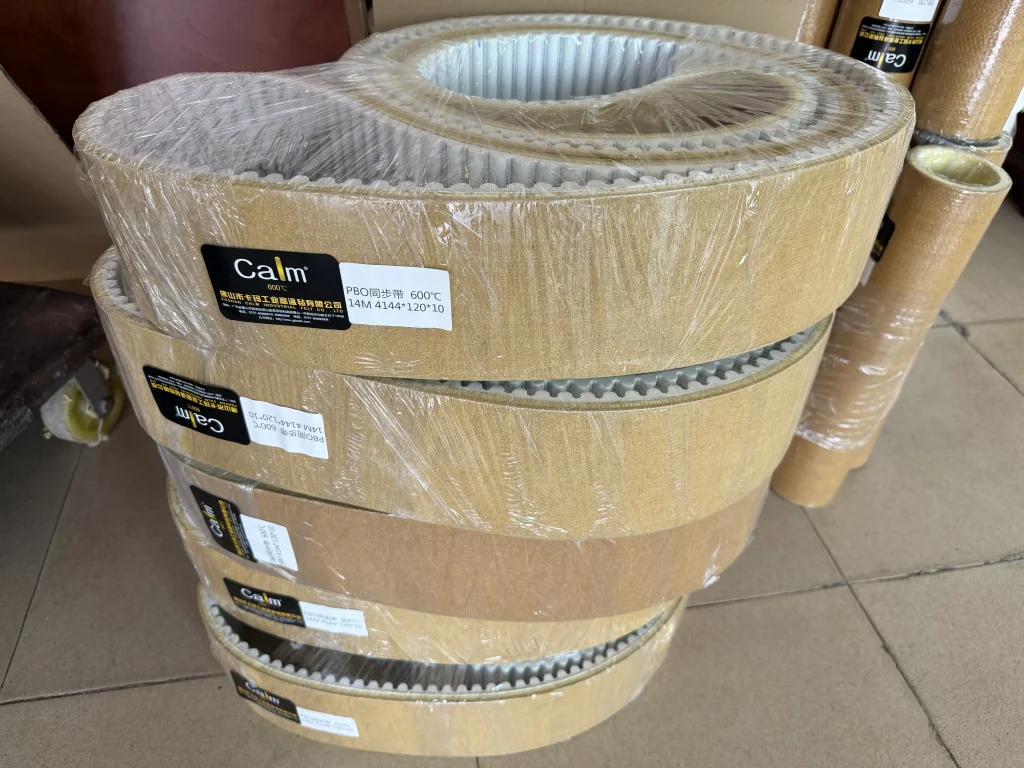
For precision transmission, a truly endless timing belt can eliminate the joint found in a joined belt. However, joined timing belts can offer greater flexibility in certain dimensions and applications.
Endless Transmission Belts
Endless transmission belts transfer power between rotating components. Round belts and other endless power-transmission belts can provide continuous operation without requiring a conventional belt splice.
Their applications include industrial machinery, material handling equipment, and other mechanical drive systems.
Endless Felt Belts
Endless felt belts are a specialized industrial belt type made from engineered felt.
Manufacturers use them when the application requires a combination of:
- Heat resistance
- Abrasion resistance
- Surface protection
- Cushioning
- Stable conveying
- Low marking
- Continuous operation
Endless needled felt belts have a particularly important application in the aluminum extrusion industry, where they can serve as conveyor belts on run-out tables and other aluminum handling systems.
What Are the Benefits of an Endless Belt?
The benefits depend on the belt material and construction, but a truly endless belt can provide several important advantages.
1. No Splice or Joint
The most obvious advantage of a truly endless belt is the absence of a connection point.
A conventional joined belt contains a section where the two ends meet. That section can behave differently from the rest of the belt. A truly endless construction removes this discontinuity.
This can be particularly valuable when the belt must maintain consistent contact with a product or operate continuously around pulleys.
2. Smoother Running
A belt without a splice can provide a more uniform running surface.
The absence of a joint can help reduce:
- Vibration
- Impact at the splice
- Uneven belt movement
- Local thickness variation
Industrial belt manufacturers identify smooth running and reduced vibration as important advantages of truly endless constructions.
3. Consistent Surface Contact
For applications where the belt directly contacts the product, surface consistency can be especially important.
An uneven splice can create marks or localized pressure on sensitive products. A continuous belt surface can help maintain more uniform contact.
This is particularly relevant when handling:
- Aluminum profiles
- Finished metal surfaces
- Sensitive components
- Printed materials
- Other products that can be marked by a belt joint
4. Reduced Risk of Splice-Related Failure
A splice represents a potential transition point in the belt. Under demanding conditions, repeated bending, tension, heat, or abrasion can place additional stress on this area.
A truly endless belt eliminates the splice itself, reducing the risk of failures specifically associated with the joint.
This does not mean that a seamless belt cannot fail. Material selection, belt construction, pulley design, tension, temperature, and operating conditions still determine service life.
5. Suitable for Continuous Industrial Operation
Because endless belts form a continuous loop, they work naturally with systems that require repeated circulation.
This makes them useful for:
- Continuous conveying
- Material handling
- Power transmission
- Industrial automation
- High-temperature processing
The specific belt material should always match the operating environment.
Endless Felt Belts for Aluminum Extrusion
One of the more specialized applications for endless belts is aluminum extrusion.
After an aluminum profile exits the extrusion die, it must move through the handling system while it is still hot. Run-out tables and cooling tables therefore need conveying components that can withstand repeated contact with hot aluminum while protecting the profile surface.
Endless needled felt belts are widely used for this purpose. BWF Protec, for example, identifies endless needled felt belts as a primary product for aluminum extrusion run-out tables and notes their durability, abrasion resistance, and ability to provide a gentle surface for sensitive aluminum profiles.
The continuous construction is particularly useful because the belt repeatedly contacts the aluminum profile. A uniform felt surface can help reduce the risk of marks or scratches associated with an uneven connection.
Why Is Felt Used Instead of a Conventional Conveyor Belt?
Aluminum extrusion handling requires more than simply moving the profile from one point to another.
The belt must also consider:
Temperature:
Freshly extruded aluminum can expose the conveying surface to substantial thermal loads.
Surface protection:
Finished profiles may require protection against scratches, dents, or other surface marks.
Abrasion:
The belt repeatedly contacts profiles and supporting components during continuous operation.
Running stability:
The belt must maintain stable movement while supporting repeated production cycles.
Material selection:
Different extrusion zones require different felt materials depending on the actual operating temperature and conditions.
For these reasons, industrial felt belts can offer advantages that conventional conveyor materials cannot provide in the same application.
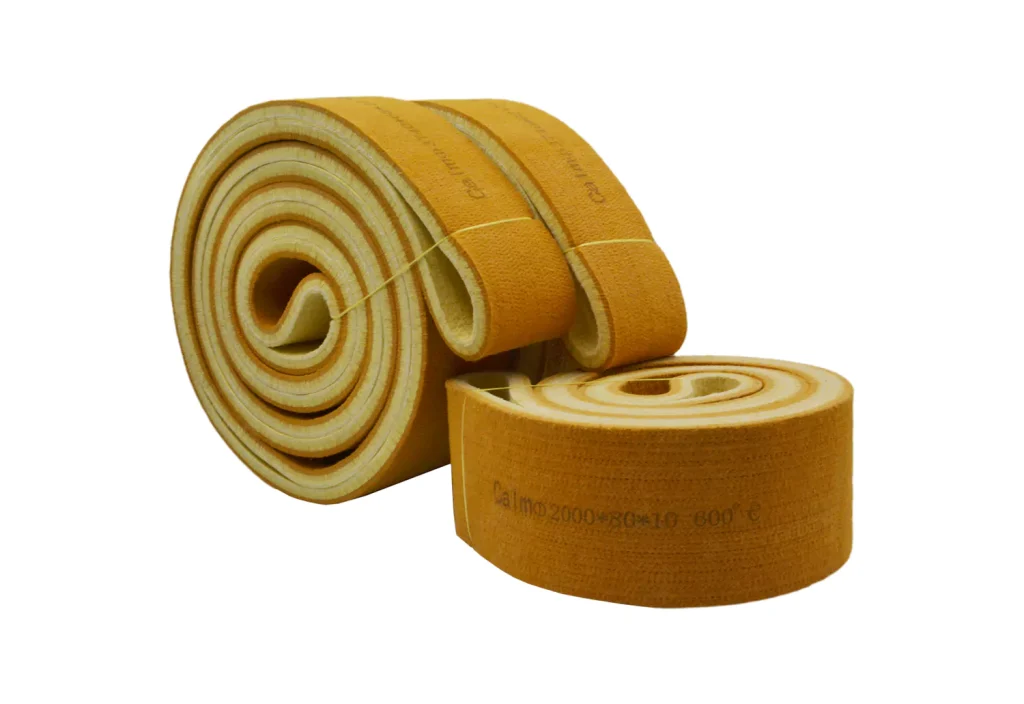
Materials Used for Endless Felt Belts
Manufacturers can use different fiber systems to produce endless felt belts for different operating conditions.
Common materials include:
- PBO
- Kevlar / para-aramid
- Nomex / meta-aramid
- Polyester
These materials do not provide identical performance.
For example, PBO and para-aramid felt constructions can serve higher-temperature applications, while polyester can be suitable for lower-temperature zones. The appropriate material depends on the actual temperature, contact conditions, belt construction, and required service life.
Industrial suppliers currently offer different felt constructions specifically for aluminum extrusion handling, including PBO, Kevlar, Nomex, and polyester endless felt belts.
Do not select a felt belt based only on the fiber’s nominal temperature resistance. The finished belt construction and actual operating conditions matter just as much.
How to Choose the Right Endless Belt
Choosing an endless belt requires more than specifying the belt length.
1. Identify the Application
First determine whether the belt will be used for:
- Conveying
- Power transmission
- Synchronized movement
- Aluminum extrusion handling
- High-temperature material handling
- Other industrial processes
The application determines which belt construction makes sense.
2. Determine the Operating Temperature
For heat-intensive applications, identify:
- Continuous operating temperature
- Peak temperature
- Contact temperature
- Exposure duration
- Cooling conditions
This information is particularly important when selecting endless felt belts.
3. Choose the Appropriate Material
Material selection should match the actual operating environment.
For aluminum extrusion, different zones of the handling system may require different felt materials. Using a higher-temperature material where it is not necessary can increase cost, while using an unsuitable lower-temperature material can shorten belt life.
4. Check Belt Dimensions
Specify the required:
- Length
- Width
- Thickness
- Density
- Belt structure
- Pulley diameter
For endless felt belts, the dimensions should correspond closely to the existing handling equipment.
5. Consider Surface Requirements
If the belt directly contacts a finished aluminum profile or another sensitive product, surface characteristics become especially important.
Look for a construction that provides:
- Uniform surface
- Low marking
- Appropriate density
- Adequate abrasion resistance
- Stable running characteristics
6. Consider Truly Endless vs. Joined Construction
A truly endless belt can be advantageous when the application requires:
- Consistent surface contact
- Smooth running
- No splice-related weak point
- Stable operation
- Continuous industrial use
However, a joined belt may remain a practical option when installation flexibility, specific dimensions, or replacement requirements are more important.
Endless Belt vs. Joined Belt: Which Is Better?
Neither construction is universally better.
A truly endless belt is generally more attractive when consistent running, uninterrupted surface contact, and the elimination of a splice are critical.
A joined belt can be useful when the user needs greater flexibility in dimensions, installation, or replacement. Barbieri’s comparison of truly endless and joined timing belts illustrates this trade-off: truly endless belts can offer higher tensile performance and stability, while joined belts provide greater flexibility in producing custom lengths and dimensions.
The correct choice therefore depends on:
Application + operating conditions + belt material + equipment design + performance requirements.
FAQs
An endless belt is a belt configured as a continuous closed loop for continuous movement around pulleys, rollers, or other components. It may be manufactured as a truly seamless loop or created by joining its ends.
Not always. A truly seamless belt has no splice or connection point, while an endless belt can also refer to a belt that has been joined into a closed loop.
A truly endless belt is manufactured as a continuous loop without a splice or joint. This construction can provide more uniform running and surface characteristics than a joined belt.
Endless felt belts are used in industrial conveying and material-handling applications, including aluminum extrusion, metal processing, and other processes requiring heat resistance, abrasion resistance, and a gentle conveying surface.
They can withstand demanding thermal and mechanical conditions while providing a relatively soft, consistent contact surface that helps protect aluminum profiles during handling.
Conclusion
An endless belt is not a single type of belt but a continuous-loop configuration used across conveying, transmission, timing, and specialized industrial applications. Truly endless construction can provide advantages such as smooth running, consistent surface contact, and the elimination of splice-related weaknesses.
For high-temperature material handling, endless felt belts provide a specialized solution, particularly in aluminum extrusion where both thermal resistance and surface protection matter. Choosing the right material and construction based on the actual operating conditions is essential for reliable belt performance.
Need a high-temperature endless felt belt for aluminum extrusion? Contact CALM at [email protected] for tailored material, size, and belt construction solutions.