The main differences between Kevlar, carbon fiber, and fiberglass lie in their strength, stiffness, impact resistance, weight, and cost. Kevlar® is known for its toughness and resistance to impact and abrasion, carbon fiber offers high stiffness at low weight, and fiberglass provides a versatile, cost-effective option for many composite applications.
The right material depends on the loads it must withstand, the environment in which it operates, and the performance required from the finished product.
1. What Are Kevlar, Carbon Fiber, and Fiberglass?
Although all three materials are used in industrial applications and fiber-reinforced composites, they have different compositions and mechanical characteristics.
Kevlar: A High-Performance Aramid Fiber
Kevlar® is a brand of para-aramid fiber developed for applications requiring high strength, toughness, and resistance to abrasion and tearing. Its molecular structure contributes to its high tensile strength relative to weight.
Kevlar is widely used in protective equipment, ropes, technical textiles, and fiber-reinforced composites. Its ability to absorb energy makes it useful in applications involving impact or repeated mechanical stress.
However, Kevlar is not ideal for every structural application. Its compressive performance and stiffness differ from those of carbon fiber, and its properties depend on the fiber grade and product construction.
Carbon Fiber: A Lightweight, High-Stiffness Material
Carbon fiber consists primarily of carbon atoms arranged in a structure that provides high stiffness and strength along the fiber direction. It is commonly incorporated into polymer composites to produce lightweight components with high structural performance.
Applications include aerospace components, automotive parts, sporting goods, and industrial structures where reducing weight without sacrificing stiffness is important.
Carbon fiber’s performance is strongly influenced by fiber orientation and composite design. It can also be vulnerable to impact-related damage, and internal damage may not always be obvious from the surface. Unlike Kevlar and fiberglass, carbon fiber is electrically conductive, which can affect its suitability around electrical systems and dissimilar metals.
Fiberglass: A Versatile Glass-Fiber Reinforcement
Fiberglass is made from fine glass fibers and is widely used to reinforce polymers and other composite materials. It offers a useful combination of strength, durability, corrosion resistance, and electrical insulation.
It is common in boat hulls, storage tanks, pipes, construction products, electrical components, and industrial equipment.
Compared with carbon fiber, fiberglass generally has lower stiffness, but it is often more economical and offers sufficient performance for many applications. Its properties vary by glass-fiber type, fiber orientation, and composite construction.
2. Kevlar vs. Carbon Fiber vs. Fiberglass: Key Differences
The following comparison summarizes the typical characteristics of these materials. Actual performance depends on the specific fiber grade and whether the material is used as a fiber, fabric, or finished composite.
| Property | Kevlar | Carbon Fiber | Fiberglass |
|---|---|---|---|
| Material type | Para-aramid fiber | Carbon-based fiber | Glass fiber |
| Main advantage | Toughness and impact-energy absorption | High stiffness and low weight | Versatility and cost-effectiveness |
| Tensile performance | High tensile strength relative to weight | High strength along the fiber direction | Good tensile performance in reinforced composites |
| Stiffness | Generally lower than structural carbon fiber | Typically the highest of the three in comparable structural applications | Generally lower than carbon fiber |
| Impact behavior | Often effective at absorbing impact energy | Can suffer impact-related matrix or fiber damage | Performance depends on fiber type and composite design |
| Abrasion and tear resistance | Often a strong choice for demanding applications | Depends on composite construction and surface protection | Depends on fiber architecture and matrix |
| Electrical properties | Generally nonconductive | Electrically conductive | Generally electrically insulating |
| Relative cost | Typically higher than standard fiberglass | Typically higher than standard fiberglass | Often the most economical option |
These comparisons describe general trends rather than universal rankings. A woven Kevlar fabric, a unidirectional carbon-fiber laminate, and a fiberglass composite cannot be ranked accurately without considering their construction and the loading conditions.
Strength vs. Stiffness
Strength and stiffness describe different properties.
Strength indicates how much stress a material can withstand before a specified form of failure. Stiffness describes how strongly it resists deformation under load.
Carbon fiber is often selected when a component must remain rigid while minimizing weight. Kevlar is attractive when toughness and impact resistance are important. Fiberglass offers a practical balance when extremely high stiffness is not essential.
A material with greater stiffness is not necessarily more resistant to impact, and high tensile strength does not guarantee strong performance under compression or bending.
Impact Resistance and Toughness
Kevlar is particularly useful in applications where absorbing energy, resisting tearing, or limiting penetration is important. Its fibers can undergo substantial deformation and absorb energy before failure.
Carbon-fiber composites can provide excellent structural performance but may develop matrix cracking, delamination, or fiber damage after an impact. The extent of damage depends on the laminate design and impact conditions.
Fiberglass composites can also provide useful impact resistance and damage tolerance. Their behavior depends on the glass-fiber type, resin system, laminate thickness, and reinforcement architecture.
For components exposed to repeated impacts or abrasion, compare the performance of the complete product under representative conditions rather than relying solely on published tensile-strength values.
Weight and Density
All three materials can be used to manufacture lightweight products, but their finished component weights depend on the fiber content, resin system, and design.
Carbon fiber is particularly attractive when low weight and high stiffness are required. Kevlar offers high strength relative to weight and can be valuable where impact resistance is also important. Fiberglass is generally heavier than carbon fiber for comparable structural stiffness, but it can still provide substantial weight savings compared with many metal alternatives.
The relevant comparison is often the weight of the finished component that meets the required performance, not simply the density of the raw fiber.
Heat Resistance and Environmental Performance
The three materials behave differently under heat, moisture, chemicals, and ultraviolet exposure.
Kevlar has useful thermal stability and does not readily melt like conventional thermoplastic fibers. However, prolonged heat exposure can degrade its mechanical properties.
Carbon fiber retains its intrinsic structural characteristics at high temperatures, but the resin in a carbon-fiber composite may soften or degrade well below the temperatures the fiber itself can withstand. High-temperature applications therefore require a suitable matrix and complete composite design.
Fiberglass is noncombustible as a glass fiber and can offer good thermal and chemical resistance. However, the performance of a fiberglass composite also depends on its resin, which may burn, soften, or degrade under heat.
For any of these materials, verify the temperature limits and environmental compatibility of the finished product. Raw-fiber properties alone do not establish the service limits of a composite or industrial component.
3. What Is Each Material Best Used For?
The most suitable material depends on the application’s primary performance requirement.
When Should You Choose Kevlar?
Kevlar is worth considering when an application requires a combination of tensile strength, toughness, abrasion resistance, and impact-energy absorption.
Common applications include:
- Protective clothing and equipment designed for specific impact or cut hazards.
- Ropes, cords, and reinforcement components.
- Composite panels and components exposed to impact.
- Industrial textiles requiring abrasion resistance or high mechanical strength.
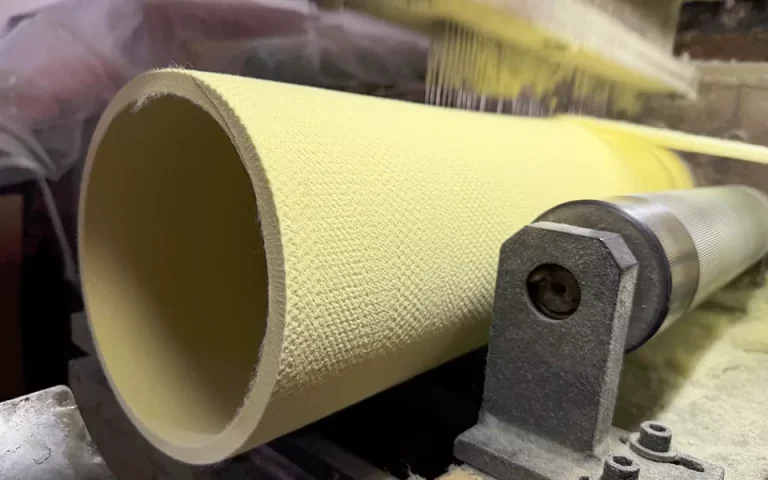
- Selected industrial felt products and other technical fiber components.
In industrial felt applications, Kevlar may be used where mechanical wear and thermal exposure occur together. However, the performance of Kevlar felt depends on its fiber blend, density, structure, and operating conditions. Properties of Kevlar composite armor or woven fabric should not be directly attributed to a felt product.
When Should You Choose Carbon Fiber?
Carbon fiber is generally a strong candidate when a component must be lightweight and structurally rigid.
Typical applications include:
- Aerospace structures and components.
- Lightweight automotive and motorsport parts.
- Bicycle frames and other sporting equipment.
- Robotics and precision equipment structures.
- Industrial components with demanding stiffness-to-weight requirements.
Carbon fiber is particularly valuable when reducing structural mass can improve efficiency or performance. However, designers must consider impact damage, joining methods, electrical conductivity, repairability, and material cost.
When Should You Choose Fiberglass?
Fiberglass is often appropriate when a project needs a durable, corrosion-resistant, electrically insulating, and economical composite material.
Common applications include:
- Boat hulls and marine structures.
- Pipes, tanks, and corrosion-resistant equipment.
- Building panels and construction components.
- Electrical enclosures and insulation-related products.
- Industrial covers, housings, and composite structures.
Fiberglass is a practical choice for many applications that do not require the stiffness of carbon fiber or the specialized impact performance associated with Kevlar. The appropriate glass-fiber type and resin system still need to match the operating environment.
4. How Do You Choose the Right Material for Your Application?
Instead of selecting a fiber based on a single headline property, evaluate the complete set of performance requirements.
Identify the Main Type of Load
Determine whether the component primarily experiences tension, compression, bending, impact, abrasion, or repeated cyclic loading.
Carbon fiber is often favored for high-stiffness structural loads. Kevlar may be advantageous where impact energy, tearing, or abrasion is a concern. Fiberglass can provide a balanced solution for many general structural applications.
If multiple load types are present, assess the material under the combined loading conditions.
Establish Weight and Stiffness Requirements
If minimizing weight while maintaining rigidity is the main objective, carbon fiber deserves close consideration.
If toughness and impact resistance are more important than maximum stiffness, Kevlar may be more suitable. Where moderate stiffness and durability are sufficient, fiberglass may meet the requirements at a lower cost.
The finished component’s geometry and reinforcement orientation can significantly affect the outcome.
Evaluate Temperature and Environmental Exposure
Check the operating temperature, exposure duration, moisture, chemicals, and ultraviolet radiation. Consider how these conditions affect both the fibers and any matrix, coating, or binder.
For industrial felt products, also assess contact pressure, friction, and surface wear. A fiber that performs well in a composite panel may behave differently when manufactured into a felt pad or roller covering.
Consider Manufacturing and Maintenance
The materials differ in handling, processing, joining, repair, and inspection requirements.
Carbon-fiber composites may require more specialized manufacturing processes and careful electrical isolation in certain assemblies. Kevlar fabrics and fibers can present different cutting and machining challenges. Fiberglass composites are widely manufactured using processes such as hand lay-up, infusion, and pultrusion.
Choose a material that can be manufactured consistently and maintained effectively throughout the intended service life.
Compare Total Application Cost
Raw-material price is only one part of the cost. Manufacturing complexity, waste, repairability, replacement frequency, and the cost of component failure also matter.
Fiberglass may offer the best overall value for general structural applications. Carbon fiber can justify its higher cost where weight reduction and stiffness provide significant benefits. Kevlar may be worthwhile where its toughness and abrasion resistance improve safety or service life.
The most economical option is the one that meets the required performance reliably, not necessarily the material with the lowest purchase price.
5. Can Kevlar, Carbon Fiber, and Fiberglass Be Combined?
Yes. Kevlar, carbon fiber, and fiberglass can be combined in hybrid composite structures when their different properties serve complementary purposes.
For example, a hybrid laminate may use carbon fiber to provide stiffness and Kevlar in selected layers to improve impact-energy absorption. Fiberglass may be incorporated to balance cost, electrical insulation requirements, or other design considerations.
However, combining fibers does not automatically improve every property. The result depends on the fiber orientation, resin compatibility, layer sequence, interface quality, and manufacturing process.
Hybrid composites should be designed and tested for the intended loading conditions. Their performance cannot be predicted simply by averaging the properties of the individual fibers.
FAQs
Is Kevlar stronger than carbon fiber?
Neither material is universally stronger. Carbon fiber often offers greater stiffness, while Kevlar is valued for toughness and impact-energy absorption. Tensile strength depends on the specific fiber grade, orientation, and finished product.
Is fiberglass stronger than Kevlar?
It depends on the property being measured and the form of the material. Kevlar generally offers advantages in certain high-strength, impact-resistant, and abrasion-resistant applications, while fiberglass can provide excellent structural performance in appropriately designed composites. Comparisons should use equivalent products and test conditions.
Which material is the lightest?
Carbon fiber is commonly selected for lightweight, high-stiffness structures. However, the weight of a finished component depends on its geometry, fiber content, matrix, and the amount of material required to meet the design loads.
Which material offers the best impact resistance?
Kevlar is often preferred for applications requiring high toughness and impact-energy absorption. However, impact resistance depends on the finished product’s construction, and some fiberglass or hybrid composites may also provide suitable performance for particular impact conditions.
Which material is more cost-effective?
Fiberglass is generally the most economical of the three for many conventional composite applications. Carbon fiber and Kevlar typically cost more, but either may provide better overall value when its specific performance advantages reduce weight, damage, maintenance, or replacement costs.
Conclusion
Kevlar, carbon fiber, and fiberglass serve different purposes. Kevlar is particularly useful for toughness and impact resistance, carbon fiber excels in lightweight, high-stiffness structures, and fiberglass provides a versatile, economical solution for many composite applications. The right choice depends on the actual loads, environment, manufacturing requirements, and performance expected from the finished product.
Looking for the right Kevlar felt for your industrial application? Contact CALM at [email protected] to discuss your material requirements, operating conditions, and custom specifications.